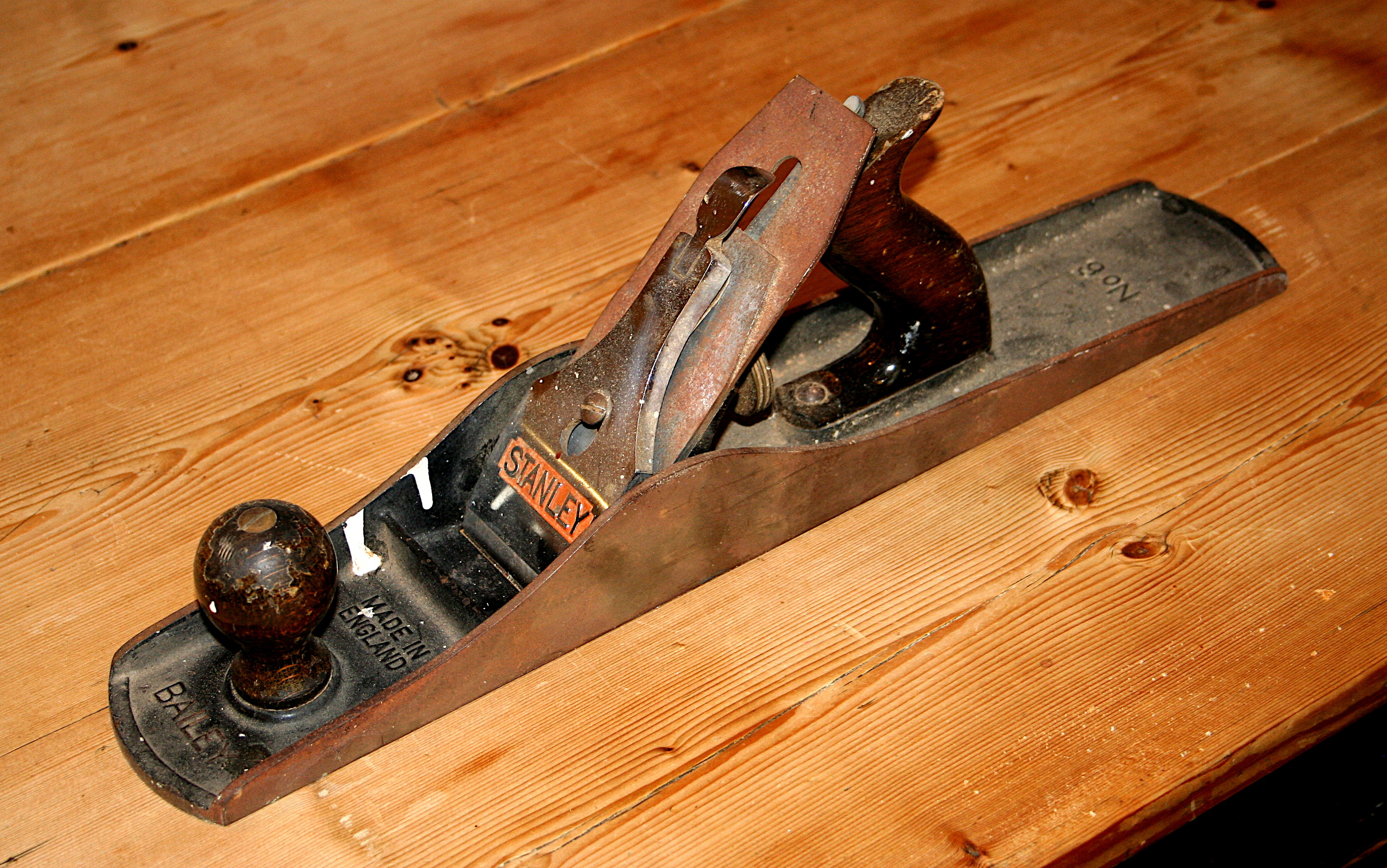
Which bench plane for what task
The numbering system on bench planes — No.3 through No.8 — corresponds roughly to length. Shorter planes follow surface irregularities; longer planes bridge and flatten them. A No.4 or No.4½ smoothing plane is used last, after a No.5 jack plane has done the rough removal and a No.6 or No.7 has flattened the panel.
For most home-workshop projects in Poland involving native hardwoods like oak (Quercus robur) or beech (Fagus sylvatica), three planes cover nearly every situation: a No.5 for stock removal, a No.7 for flatness, and a No.4 for final surface preparation before finishing.
The cap iron — the most misunderstood part
The cap iron sits on top of the blade and curls the shaving as it comes off the wood. When set close to the cutting edge — typically 0.3 to 0.5 mm — it stiffens the shaving before it separates from the surface, which prevents tear-out on difficult grain.
The exact distance varies by wood species. Beech with interlocked grain may need the cap iron within 0.2 mm of the edge. Straight-grained ash can tolerate 0.8 mm without tear-out. The cap iron edge itself must be flat and square; a gap between it and the blade face creates a shavings jam.

Setting the mouth opening
The mouth — the gap in the sole through which the blade protrudes — controls how much support the wood gets ahead of the cut. A tight mouth (small gap) gives the wood less chance to split ahead of the blade. A wide mouth allows thicker shavings for faster stock removal.
On a bevel-down plane, the frog position controls mouth width. Moving the frog forward tightens the mouth. Stanley-pattern planes have a frog-adjustment screw accessible from behind; moving it a quarter turn can make a meaningful difference.
Reading grain direction
Planing against the grain — commonly called "planing uphill" — causes the fibres to be lifted before they sever, leaving a rough, torn surface. The grain direction is visible on the edge of the board as a series of lines angling toward or away from you. Always plane so the lines angle upward in the direction of travel.
On quartersawn boards — common in Polish oak — the grain runs nearly vertical to the face and is more forgiving. On flatsawn boards, particularly near the pith, reversing grain direction mid-board forces you to work from two directions, meeting in the middle.
Sharpening before and after
No amount of setup compensates for a dull edge. A sharp plane iron cuts with a faint hiss and produces translucent shavings. A dull iron requires noticeably more pressure, produces thicker, crumpled shavings, and leaves a faintly burnished surface that resists finish absorption.
For bench planes used on hardwood, a 25° primary bevel with a 30° microbevel is a practical starting point. Waterstones at 1000, 3000, and 8000 grit, followed by stropping on leather charged with 1-micron chromium oxide, produce a serviceable edge in under five minutes once the primary bevel is established.
Sharpening sequence
- Grind or establish the primary bevel at 25° (done infrequently, only when the edge is damaged or very dull)
- Hone the microbevel at 30° on a 1000-grit stone until a wire edge forms on the flat back
- Remove the wire edge by pulling the flat back across the 1000-grit stone two or three times
- Polish on 8000 grit — five strokes on the bevel, two on the back, repeat once
- Strop on leather — ten strokes each side
Working with common Polish hardwoods
Oak is dense and has pronounced ray cells that reflect light — the figure many woodworkers are after. It also has silica deposits that dull edges faster than most European species. Sharpen more often, and keep the cap iron closer than you would on softer woods.
Beech is even-grained and responds well to sharp tools at most angles. It is the standard workbench timber in Poland — available in large, stable sections at most timber merchants (tartak). Ash is slightly softer, planes cleanly, and bends well when steamed.
Pine and spruce are common and inexpensive but require a very sharp, fine-set iron. The resin can gum up the blade; cleaning with a rag dampened with mineral spirits keeps things moving.
Common problems and their causes
Chatter: The blade is not clamped firmly. Tighten the lever cap, check that the chipbreaker fits flat against the blade, and check that the frog is firmly seated.
Shavings jamming in the throat: Either the mouth is too tight for the thickness of shaving being taken, or the cap iron has a gap. Widen the mouth slightly or regrind the cap iron face flat.
Plane tracks along edges of blade: The blade corners are not rounded off. Lightly round the outermost 3–4 mm of each corner with a sharpening stone. A very slight camber ground into the blade — barely perceptible, perhaps 0.1 mm rise at centre — also eliminates tracks for final smoothing work.
Tear-out on difficult wood: Move the cap iron closer to the edge. If tear-out persists, try planing at an angle across the grain (skewing the plane 20–30°), which effectively increases the cutting angle.

