Space requirements
A functional hand-tool workshop fits in roughly 12–15 m². The bench takes up around 1.8 × 0.7 m of floor space, and you need at least 1.2 m of clear floor on three sides to work long boards. That leaves room for a tool cabinet, a sharpening station, and basic storage.
In Poland, basement storage rooms (piwnica) in block apartment buildings are sometimes available for rent from housing cooperatives (spółdzielnia mieszkaniowa). Dimensions vary, but units of 10–20 m² are common in post-war residential buildings. Confirm that the ceiling height is at least 2.2 m and that there is an accessible power outlet.
The workbench
The bench is the most important piece of equipment in a hand-tool workshop. Its mass, rigidity, and clamping system determine how much effort goes into holding work rather than cutting it. A light, flimsy bench converts muscular effort into vibration.
Two bench designs dominate hand-tool practice: the Roubo (French joiner's bench) and the Nicholson (English carpenter's bench). The Roubo has a thick slab top, a leg vise at the front left, and a tail vise at the right end. The Nicholson has an apron along the front face that doubles as a clamping surface — simpler to build, still effective.
Bench height should place the palm flat on the top surface when you stand with arms hanging relaxed. For most adults, this falls between 82 and 88 cm. A bench set too low strains the lower back during planing; too high reduces leverage.
Building vs. buying in Poland
Commercial benches with solid wood tops are available through Polish woodworking suppliers and general hardware chains (Castorama, OBI, Leroy Merlin). Quality varies significantly. Benches sold as DIY workbenches typically have tops of 18 mm MDF or thin softwood with excessive flex. A bench intended for hand-tool use needs a top at least 60 mm thick — ideally 90–100 mm — in beech or maple.
Building a bench from Polish beech (buk) sourced from a local sawmill (tartak) is economical and produces a more appropriate result. A basic Nicholson bench requires approximately 0.15 m³ of beech — roughly 100–130 kg of air-dried timber. At current Polish tartak prices (around 1800–2400 PLN per m³ for air-dried beech), the material cost for the top is 270–360 PLN.

Lighting
Adequate lighting is frequently underestimated. Cutting to a knife line requires seeing the line, and seeing the line requires raking light — light that comes from a low angle so it casts small shadows across surface features.
A single fluorescent or LED strip mounted directly above the bench creates even, flat illumination that hides surface irregularities. Better is a combination of overhead ambient light for general visibility and an adjustable lamp — a classic anglepoise type — positioned to create raking shadows across the work surface when assessing flatness.
For workshop use in Poland, 4000–5000 K LED strips provide neutral white light that allows accurate colour judgment when selecting and matching timber. Very warm (2700–3000 K) or very cool (6500 K) light distorts colour perception.
Ventilation and dust
Hand-tool work produces far less dust than machine work. Planing a board produces visible shavings but minimal airborne dust. Sawing and chiselling produce fine particles, but at much lower volumes than a thickness planer or table saw.
A window that can be opened and a basic box fan for cross-ventilation is adequate for most hand-tool work. If you introduce a bandsaw or drill press, consider a simple dust collector at the machine source.
Working with oak generates tannic acid particles that irritate mucous membranes. An N95 respirator worn during extended sanding or chopping is a reasonable precaution. The occupational limit for wood dust in Poland (as set by Ministerstwo Pracy i Polityki Społecznej) is 1 mg/m³ for hardwood dust — easily exceeded during sustained sanding without dust collection.
Sourcing timber in Poland
Poland has significant forestry and processing capacity. Timber merchants (skład drewna) exist in most towns of any size. For furniture-grade hardwood, a tartak (sawmill) is a better source than a building supply store — you have more control over selection and can inspect individual boards for defects, figure, and moisture content.
Moisture content below 12% is necessary for indoor furniture work. Most Polish tartaki sell air-dried timber at 15–20% moisture content; kiln-dried (suszone komorowo) timber at 8–12% commands a premium but is available. A basic pin-type moisture meter (available for 60–120 PLN at electronic suppliers) eliminates guesswork at the point of purchase.
Species commonly available at Polish timber merchants:
- Dąb (oak): Dense, durable, difficult to work by hand but worth the effort for furniture. Ray figuring on quartersawn boards is striking.
- Buk (beech): Uniform, machines and planes beautifully. Standard material for workbenches and tool handles. Moves with humidity changes — not ideal for large panels unless stablised.
- Jesion (ash): Strong, flexible, open-grained. Excellent for chair legs and bent components.
- Sosna (Scots pine): Inexpensive, widely available, easy to work. Suitable for workshop furniture, jigs, and secondary wood in furniture construction.
- Lipa (lime/linden): Very soft and easy to carve. Used for carving, turning, and pattern-making.
Tool storage
Hand tools stored in drawers or boxes accumulate contact damage — chisels dull each other, plane blades rust, saws bend. A wall-mounted tool cabinet with individual holders keeps edges protected and tools visible.
A simple approach: a sheet of 12 mm plywood screwed to the wall, with chisel racks made from a strip of wood with saw-kerf slots, saw hooks made from bent nails, and plane storage on a shelf with a chamfered front edge that the plane sits behind so it does not rest on its blade.
In basement workshops with concrete walls, controlling humidity is important. A dehumidifier rated for the room size, run during wet seasons, prevents rust. Plane bodies, saw plates, and chisels benefit from a light coat of Renaissance Wax or camellia oil on exposed metal surfaces between uses.
A minimal starting kit
Planes (3 to start)
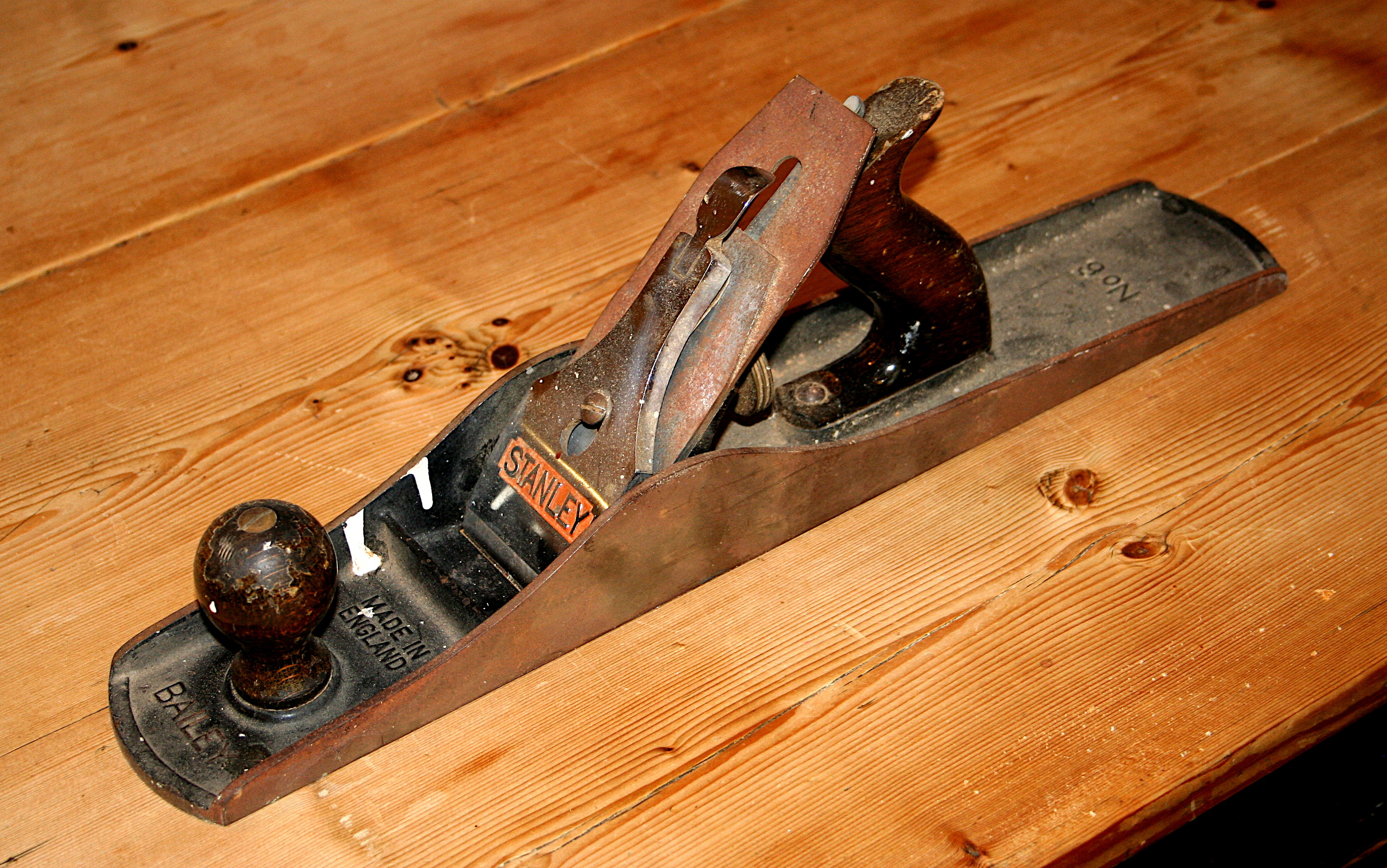
No.5 jack plane, No.4 smoothing plane, shoulder plane. A No.7 jointer is next.
Chisels
6 mm, 12 mm, 19 mm, 25 mm bench chisels. One 8 mm mortise chisel. All from the same maker for consistent steel behaviour.
Saws
Rip tenon saw (8–10 tpi), dovetail saw (14–16 tpi), coping saw for waste removal.
Measuring and marking
Try square (200 mm), sliding bevel, marking gauge, mortise gauge, marking knife, 1 m rule, tape measure.
Where to buy tools in Poland
Specialty woodworking tools are available from Polish and German online suppliers. Dictum (dictum.com, German, ships to Poland) and Narzędzia (narzedzia.pl) carry hand-tool stock. Second-hand tools — particularly older Stanley and Record planes — appear regularly on Allegro, often in serviceable condition and at a fraction of new prices.